8.1 Scope the decision path, including selection before the final decision
Proposed practice. Identify actions that make or materially influence a covered decision. Include document requests, evidence retrieval, missing-data handling, routing, prioritization, recommendations, escalation, notices, and redress. A flow can disadvantage a group before it reaches the model that receives the formal fairness review.
The ARIA finance architecture illustrates collective exclusion and drift monitoring in constructed simulations. It supplies mechanisms to test and an architectural hypothesis. Its authors explicitly do not establish production effectiveness. The enterprise response should therefore be a falsifiable test plan and observed outcome monitoring. [S23]
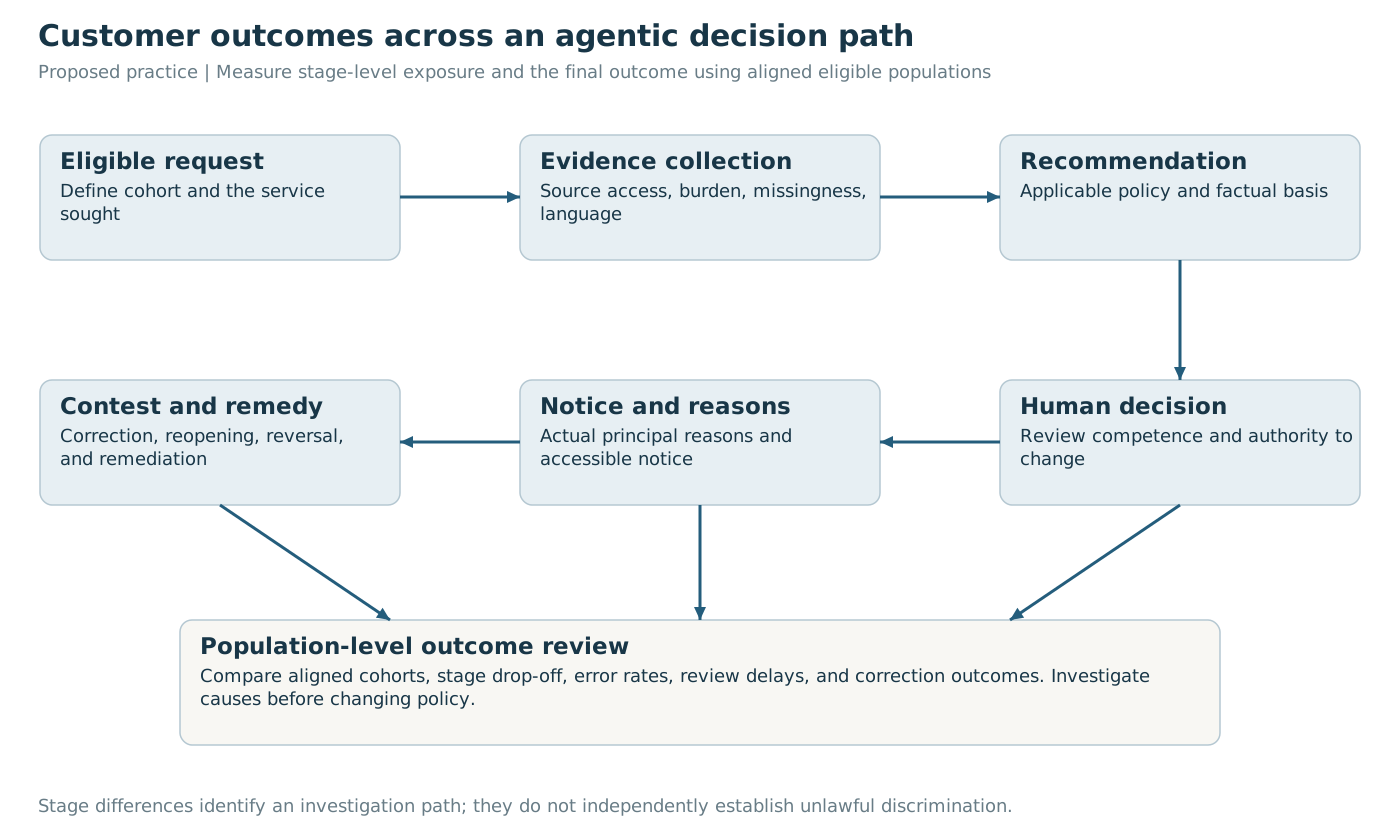
Figure 7. Proposed decision-path review. Align eligible cohorts at each stage so that a favorable final-stage rate cannot conceal an earlier exclusion. The diagram contains no measured customer data.
| Review dimension | Proposed analysis | Interpretation discipline |
|---|---|---|
| Access to the process | Compare eligible entry, completion, and drop-off across relevant groups. | Define eligibility and investigate access barriers before attributing a difference to agent bias. |
| Evidence burden | Compare extra-document requests, repeated questions, and unresolved missingness. | Distinguish legitimate policy needs from uneven treatment. |
| Tool and source selection | Inspect which evidence the agent considers and ignores. | Shared data gaps can affect many components simultaneously. |
| Errors and intervention | Compare incorrect outcomes, false escalations, delays, and critical misses. | Use the same labeling criteria and report uncertainty and small cells. |
| Human review | Measure reviewer errors and ability to change the outcome. | A human signature does not by itself establish meaningful oversight. |
| Reasons and notice | Compare stated reasons with the actual decision record. | A fluent explanation can be factually wrong or legally inadequate. |
| Contest and correction | Track reopening, reversal, resolution delay, and recurring causes. | Differences indicate a review need; they are not automatically causal or unlawful. |
8.2 Preserve the actual reasons for adverse action
Regulation B's notification provisions require specific principal reasons for covered adverse action, subject to the applicable rule and procedural alternatives. The governing text, rather than an agent's generated explanation, is the source for the obligation. [S37]
Proposed practice. Capture the factual and policy basis that actually influenced a covered decision. Link it to the configured workflow and to any independently validated quantitative model used within it. An agent may help draft a notice using an approved reason vocabulary and recorded facts; the notice must be checked against the actual basis. Do not infer legal reasons from raw chain-of-thought or from an unsupported post-hoc narrative.
8.3 Human reviewers need competence, access, and authority
Proposed practice. Specify the reviewer's decision rights, available evidence, time budget, conflict rules, escalation path, and authority to reverse or suspend. Train with normal cases and seeded failures that test factual reasoning, scope, consent, and customer rights. Review samples where humans disagreed with the agent, agreed with it, and failed to notice a planted error.
Measure reviewer competence over time. Include performance under peak queue load, unavailable evidence, language differences, accessibility needs, and ambiguous instructions. A reviewer who cannot obtain the relevant evidence or change the result cannot supply the intended operating control.
8.4 Fairness screening is an investigation method
Proposed practice. Predefine outcomes, relevant groups, lawful data use, minimum reportable cell sizes, confidence methods, and escalation criteria. Use matched and counterfactual cases where appropriate, and observed production cohorts where permitted. Investigate overlapping group membership, differences in eligibility, geography, task difficulty, and missing data.
Do not treat a universal selection-rate ratio as a safe harbor across lending, insurance, hiring, and other domains. Do not convert small-cell uncertainty to a zero-disparity conclusion. Retain an alternative-design record: policy simplification, different evidence requests, earlier human routing, constrained tool selection, and accessibility changes can all be tested against the original workflow.