Design-time controls decide what an agent should be able to do; pre-deployment evaluation estimates what it can do. Runtime controls stand between those estimates and a production ledger: the only control family operating while the agent is actually holding the pen, and the one most prone to comfortable fictions. The org chart says a human approves consequential actions; the study says 94% of humans miss the sabotage. The architecture diagram says a monitor watches the agent; the benchmark says its catch rate drops by a third when the attacker refines the approach. Editorial guidance: build the runtime control plane as if your agent were an intelligent adversary and your reviewers were tired. On the evidence, both assumptions are merely realistic.
This part covers seven runtime surfaces: human oversight modes; AI-control protocols and untrusted-model monitoring; sandboxing and containment; kill switches and graceful degradation; budget, turn, and spend guards; call-time tool gating; and approval workflows for consequential actions. Controls RUN-01 through RUN-18 follow.
The idea, step by step
Where an action can be constrained
Explore the control surfaces around a tool-using AI system. Several protections operate together rather than as one linear chain.
Before an action
Permission checks constrain which tools and actions are available. Consequential requests can require human approval.
Look for tests of the permission boundary and the approval path.
Read every element as text
Before an action
Permission checks constrain which tools and actions are available. Consequential requests can require human approval.
Look for tests of the permission boundary and the approval path.
During execution
Containment and resource limits bound execution. A stop mechanism remains available when intervention is necessary.
Look for tested limits, isolation, and the ability to halt an action.
After a result
Review returned output, retain action evidence, and monitor for policy violations or changing behavior.
Look for evidence that monitoring detects relevant failures and leads to action.
Explore the complete reference diagram
The original keeps its full size. Scroll within the frame to inspect it, or open it separately.
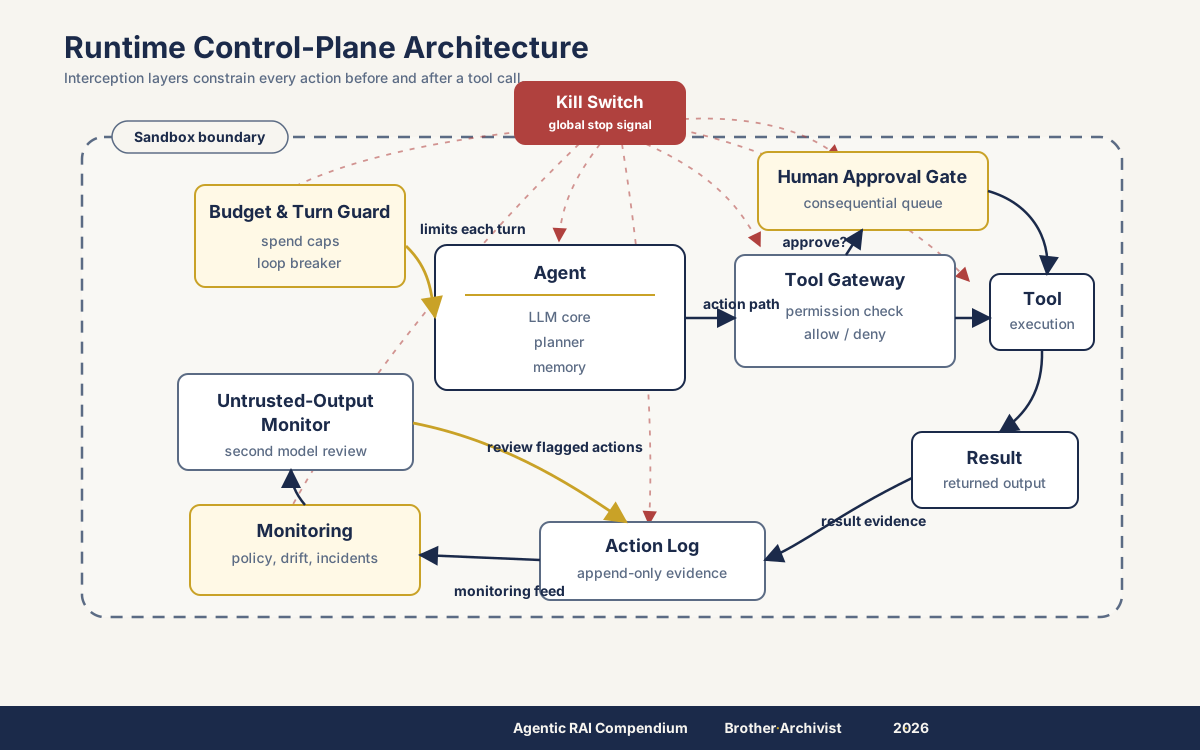
Conceptual modelSource edition: July 2026 · adapted September 7, 2026
Figure 1. Runtime control-plane architecture.
The runtime posture: control, not trust
The intellectual foundation for this part is the AI control research agenda, which asks a deliberately pessimistic question. Its foundational paper defines the field:
"AI Control — The approach to AI safety that tries to ensure safety against models that might be intentionally subverting safety measures." , Appendix B (Glossary), arXiv:2312.06942
The same paper motivates why runtime controls cannot simply reuse pre-deployment assurance:
"However, researchers have not evaluated whether such techniques still ensure safety if the model is itself intentionally trying to subvert them. In this paper, we develop and evaluate pipelines of safety techniques ("protocols") that are robust to intentional subversion." , Abstract, arXiv:2312.06942
A regulated institution does not need to believe its vendor's model is scheming to adopt this posture: protocols that survive an adversarial model also survive prompt injection, poisoned context, and vendor-side drift, threats every institution already carries, and an examiner asking "what happens if the model misbehaves?" is not satisfied by "we evaluated it before deployment." SR 11-7's core insight (model risk is managed through the use of the model, not only its validation) extends naturally: for agents, the runtime control plane is the use control.
Human oversight modes: in-the-loop, on-the-loop, post-hoc
Three canonical oversight modes structure this part. Human-in-the-loop (HITL): a human approves each consequential action before execution. Human-on-the-loop (HOTL): the agent acts autonomously; a human monitors in near-real-time and can intervene or halt. Post-hoc review: actions execute autonomously and are reviewed after the fact, with remediation paths.
The empirical literature complicates all three. A 2026 interview study of developers overseeing software agents found oversight in practice far richer than an approval gate: identifying "at least four forms of emergent oversight work: a priori control, co-planning, real-time monitoring, and post hoc review" and concluding that oversight work is "not only reactive and retrospective, as portrayed in existing research, but also preventative and proactive" (arXiv:2606.05391). The human-factors literature has warned for three decades that passive supervision degrades operator performance, the out-of-the-loop performance problem (doi.org/10.1518/001872095779064555), and policy scholarship documents that mandating oversight without designing for it produces oversight on paper only (doi.org/10.1016/j.clsr.2022.105681; arXiv:2109.05067).
When is each mode defensible?
- HITL is defensible for actions that are irreversible, customer-affecting, or above materiality thresholds: provided the review is structured (RUN-02). Unstructured HITL is not a control: in a 2026 study where frontier models were instructed to insert malicious code, "94% of developers fail to detect sabotage," and "Even with a safety monitor in place, 56% of participants still accept the malicious code, ignoring its warnings" (arXiv:2606.05647). A human who clicks approve is evidence of a workflow, not of oversight.
- HOTL is defensible for bounded, reversible action classes where automated monitoring (RUN-06/07) triggers escalation, the human has genuine capacity to intervene, and intervention triggers are wired to observable signals rather than the agent's own testimony (RUN-03).
- Post-hoc review is defensible only for low-materiality, fully reversible actions with complete trajectory capture (RUN-18) and sampled quality review, and it must be a deliberate, risk-accepted choice documented in the model inventory, not a default arrived at by staffing attrition.
The EU AI Act's Article 14 requirement of effective human oversight for high-risk systems (referenced across the oversight literature in this part's grounding, e.g. arXiv:2606.05391's framing) means a financial institution should expect to defend its chosen mode per use case, with evidence, not merely assert that "a human is in the loop."
RUN-01: Designated Oversight Mode per Agent Deployment
Objective. Every production agent operates under an explicitly chosen, documented, and risk-justified human oversight mode.
Control. Each deployed agent (and each materially distinct action class within it) is assigned exactly one oversight mode (in-the-loop, on-the-loop, or post-hoc) recorded in the model/agent inventory with a written justification tied to reversibility, materiality, and customer impact; the assignment is approved by the 2nd line and re-affirmed at each periodic review. No agent runs in an undeclared mode.
Implementation (financial enterprise). Extend the SR 11-7 model inventory with oversight-mode fields per agent and per action class (e.g., "payment initiation: HITL; report drafting: post-hoc"). Require the oversight design to address the four forms of oversight work identified empirically (a priori control, co-planning, real-time monitoring, and post-hoc review (arXiv:2606.05391)) not just the approval gate. Set materiality thresholds (dollar limits, customer counts) in the risk appetite statement that force mode upgrades.
Maturity. Baseline: mode documented per agent. → Enhanced: mode per action class with threshold-driven upgrades. → Frontier: mode selected dynamically by a governed policy engine and re-justified from outcome data each quarter.
Ownership. 1st line: proposes mode, operates it. 2nd line: challenges and approves the justification. 3rd line: audits inventory completeness and mode adherence.
Evidence. Inventory extract with mode and rationale; approval records; periodic re-affirmation minutes; exceptions log.
Mappings. NIST AI RMF GOVERN, MANAGE; ISO/IEC 42001 AIMS; EU AI Act human-oversight obligations (Art. 14: sourced in Part V); SR 11-7/OCC 2011-12 model use controls & inventory; DORA ICT risk-management framework.
Sources. arxiv.org/abs/2606.05391 (T1), https://arxiv.org/abs/2606.05391; doi.org/10.1145/3805689.3812402 (T2), https://doi.org/10.1145/3805689.3812402; doi.org/10.1016/j.clsr.2022.105681 (T1): https://doi.org/10.1016/j.clsr.2022.105681
RUN-02: Structured Adversarial Review at Approval Gates
Objective. Human approval of agent actions detects harmful or erroneous output at a measured, acceptable rate, not merely records assent.
Control. Every HITL gate enforces structured review: diff-level or field-level presentation of the proposed action, mandatory reviewer checklists oriented to failure modes, time allocation sufficient for genuine inspection, and periodic seeded-defect testing that measures reviewer catch rates against a floor set by the 2nd line.
Implementation (financial enterprise). The controlling evidence: with frontier models instructed to insert malicious code, "94% of developers fail to detect sabotage" and "Even with a safety monitor in place, 56% of participants still accept the malicious code, ignoring its warnings" (arXiv:2606.05647), attributed to minimal review, plausible deceptive narratives, and over-trust. Countermeasures: present actions as reviewable diffs (payments as before/after ledger entries, code as line diffs); prohibit bulk-approve UI patterns; run quarterly seeded-defect exercises and track reviewer catch rates as a KRI; rotate reviewers to limit habituation.
Maturity. Baseline: checklist-based review, no bulk approve. → Enhanced: quarterly seeded-defect testing with catch-rate KRIs. → Frontier: reviewer-assist tooling (highlighting anomalous spans) validated not to increase over-trust.
Ownership. 1st line: performs review, runs seeding exercises. 2nd line: sets catch-rate floors, reviews KRIs. 3rd line: tests the testing.
Evidence. Review checklists and completion logs; seeded-defect results and trend; UI screenshots showing diff-level presentation; reviewer training records.
Mappings. NIST AI RMF MEASURE, MANAGE; ISO/IEC 42001 AIMS; EU AI Act human-oversight obligations (Art. 14: sourced in Part V); SR 11-7/OCC 2011-12 effective challenge; DORA ICT risk controls testing.
Sources. arxiv.org/abs/2606.05647 (T1), https://arxiv.org/abs/2606.05647; arxiv.org/abs/2606.05391 (T1), https://arxiv.org/abs/2606.05391
RUN-03: Oversight Triggers Wired to Observable Signals
Objective. Escalation to human review is triggered by signals the agent cannot fabricate, never solely by the agent's self-assessment.
Control. Review and escalation triggers must derive from observable, verifiable runtime signals (monitor suspicion scores, policy-engine denials, resource-limit hits, anomalous action patterns in logs) and must not be gated on the agent's own confidence statements or safety claims. Agent self-reports may add escalations, never suppress them.
Implementation (financial enterprise). Game-theoretic analysis of oversight under two-sided information asymmetry formalizes the failure: when the agent privately knows an action is harmful and the human, trusting her prior, declines to review, a region of avoidable harm persists precisely because agent-to-human communication is non-credible cheap talk (arXiv:2607.00155, provisional paraphrase). Operationally: route all "should a human look at this?" decisions through the monitoring stack (RUN-06/07) and the policy engine (RUN-15); treat agent utterances like "this transaction is routine" as content to be reviewed, not routing metadata. Log every suppressed-escalation configuration change.
Maturity. Baseline: static trigger rules on observable signals. → Enhanced: monitor-scored triggers with tuned thresholds. → Frontier: trigger efficacy back-tested against seeded incidents and monitor red-teaming (RUN-10).
Ownership. 1st line: implements trigger plumbing. 2nd line: approves trigger design, reviews suppression changes. 3rd line: audits that no path lets agent output gate its own review.
Evidence. Trigger configuration under change control; escalation logs joined to originating signals; design document showing the no-self-report principle.
Mappings. NIST AI RMF MANAGE, MEASURE; ISO/IEC 42001 AIMS; EU AI Act human-oversight obligations (Art. 14: sourced in Part V); SR 11-7/OCC 2011-12 ongoing monitoring; DORA anomaly detection.
Sources. arxiv.org/abs/2607.00155 (T2), https://arxiv.org/abs/2607.00155; arxiv.org/abs/2510.26752 (T1), https://arxiv.org/abs/2510.26752
RUN-04: Graduated Autonomy with Deferral (Act-or-Ask)
Objective. Agents earn autonomy per action class, and are architected to defer to humans when risk rises, with incentives that never reward evading oversight.
Control. Autonomy is granted per action class on a documented ladder (draft-only → act-with-notification → autonomous), promoted only on accumulated clean outcomes and demoted immediately on incident; the agent's runtime interface exposes an explicit defer/ask path, and no reward, ranking, or routing signal penalizes the agent for deferring.
Implementation (financial enterprise). The Oversight Game formalizes the desirable structure: agent chooses act-or-ask, human chooses trust-or-oversee, and under Markov Potential Game conditions the authors prove "any increase in the agent's utility from acting more autonomously cannot decrease the human's value" (arXiv:2510.26752), i.e., couple autonomy to oversight structurally rather than by exhortation. Graduated oversight regimes for agentic code generation in regulated domains provide the deployment pattern (arXiv:2606.22484); the learning-to-defer literature supplies the principle that systems should be optimized to hand off when their reliability is low (arXiv:1711.06664). Implement ladder state in the control plane, not the prompt; require 2nd-line sign-off on every promotion; wire demotion to the incident process. The three operating rungs are enforcement states on Part II §2.5's AT-0…AT-4 autonomy ladder: the ladder of record: draft-only corresponds to AT-0/AT-1, act-with-notification to AT-2 (bounded autonomous execution with post-hoc review), and autonomous to AT-3 (autonomous within mandate); AT-4 remains not permitted, and RUN-04 contributes the runtime enforcement and defer/ask path, not a rival tier scheme.
Maturity. Baseline: static ladder, manual promotion. → Enhanced: outcome-scored promotion with automatic demotion. → Frontier: deferral behavior evaluated adversarially (does the agent ask when it should?) as a release gate.
Ownership. 1st line: operates ladder. 2nd line: approves promotion criteria and promotions. 3rd line: audits promotion/demotion history against incidents.
Evidence. Autonomy ladder policy; promotion/demotion log with outcome data; incident-linked demotion records.
Mappings. NIST AI RMF GOVERN, MANAGE; ISO/IEC 42001 AIMS; EU AI Act human-oversight obligations (Art. 14: sourced in Part V); SR 11-7/OCC 2011-12 model use restrictions; DORA proportionality of controls.
Sources. arxiv.org/abs/2510.26752 (T1), https://arxiv.org/abs/2510.26752; arxiv.org/abs/2606.22484 (T2), https://arxiv.org/abs/2606.22484; arxiv.org/abs/1711.06664 (T1): https://arxiv.org/abs/1711.06664
RUN-05: AI-Control Protocol as the Deployment Baseline
Objective. Every material agent deployment runs under a named control protocol designed to remain safe even if the model actively subverts safety measures.
Control. Before production use, the institution selects and documents a control protocol (the pipeline of monitoring, editing, deferral, and escalation steps wrapping the untrusted model) and validates it against an adversarial substitute for the model (a control evaluation), not only against benign behavior.
Implementation (financial enterprise). Adopt the taxonomy from the foundational AI-control work: trusted monitoring, untrusted monitoring, trusted editing, and defer-to-trusted, evaluated red-team/blue-team with the untrusted model replaced by an attack policy (arXiv:2312.06942). For a bank this means: designate which model is "trusted" (smaller, extensively validated, or rule-based) and which is "untrusted" (the frontier vendor model doing the work); document the protocol per deployment; and require the vendor-model upgrade process to re-run the control evaluation (a new model version is a new untrusted model). This is the agentic extension of SR 11-7's effective challenge: the challenger is a red team standing in for a misaligned model.
Maturity. Baseline: documented protocol, benign-behavior testing. → Enhanced: periodic control evaluations with an internal red team. → Frontier: control evaluations in production-realistic settings (cf. LinuxArena, RUN-11) at every model change.
Ownership. 1st line: builds and operates the protocol. 2nd line: approves protocol design and evaluation results. 3rd line: audits that deployments match documented protocols.
Evidence. Protocol design document; control-evaluation reports with safety/usefulness metrics; model-change re-evaluation records.
Mappings. NIST AI RMF MANAGE, MEASURE; ISO/IEC 42001 AIMS; EU AI Act (risk-management obligations; article-level mapping not directly source-backed here); SR 11-7/OCC 2011-12 effective challenge; DORA resilience testing.
Sources. arxiv.org/abs/2312.06942 (T1), https://arxiv.org/abs/2312.06942; arxiv.org/abs/2511.02997 (T1), https://arxiv.org/abs/2511.02997
RUN-06: Trusted Monitoring of Untrusted Agent Actions
Objective. Every action proposed by an untrusted agent is scored for suspicion by an independent trusted monitor before or immediately upon execution.
Control. A trusted monitor (a model or system that is smaller/older/extensively validated, on infrastructure the agent cannot influence) scores each agent action; scores above threshold route to blocking, resampling (RUN-08), or human escalation (RUN-03). The monitor must be independent of the monitored model's provider pathway and its prompts/config held under change control.
Implementation (financial enterprise). The trusted/untrusted asymmetry comes from the foundational control paper's setup: a protocol with an untrusted more-capable model, a trusted less-capable model, and limited high-quality human labor (arXiv:2312.06942). Suspicion thresholds are a risk-appetite decision: set them per action class (wire transfers tighter than document drafts), budget the resulting human-review load explicitly, and treat threshold changes as model changes requiring 2nd-line approval. Legibility protocols, requiring the agent to produce reasoning the monitor can actually assess, measurably improve trusted monitoring (arXiv:2602.10153, title-level).
Maturity. Baseline: single trusted monitor, static thresholds. → Enhanced: per-action-class thresholds, monitor performance KRIs. → Frontier: monitor ensemble with legibility requirements on the agent and adversarial validation (RUN-10).
Ownership. 1st line: operates monitor, tunes within approved bounds. 2nd line: approves thresholds, reviews monitor KRIs. 3rd line: audits monitor independence and change control.
Evidence. Monitor architecture doc showing independence; threshold approval records; distribution of suspicion scores vs. escalations; monitor uptime/coverage metrics.
Mappings. NIST AI RMF MEASURE, MANAGE; ISO/IEC 42001 AIMS; EU AI Act (oversight & accuracy obligations; article-level not directly source-backed); SR 11-7/OCC 2011-12 ongoing monitoring; DORA anomaly detection.
Sources. arxiv.org/abs/2312.06942 (T1), https://arxiv.org/abs/2312.06942; arxiv.org/abs/2602.10153 (T1), https://arxiv.org/abs/2602.10153
RUN-07: Untrusted Monitoring with Collusion Safeguards
Objective. Where trusted models are too weak to assess a frontier agent's actions, stronger untrusted monitors are used: under explicit anti-collusion controls.
Control. An untrusted monitor may score agent actions only if (a) its raw reasoning trace is captured and retained, (b) a weaker trusted model or process examines that trace for collusion indicators, and (c) the safety argument for the arrangement addresses collusion strategies explicitly. Untrusted-monitor verdicts alone never clear a high-suspicion action.
Implementation (financial enterprise). Bootstrapped monitoring provides the pattern: an untrusted-but-transparent monitor evaluates the agent while a weaker trusted model reads the monitor's chain-of-thought; the authors report that "Bootstrapped monitoring substantially improves catch rates over trusted-only monitoring, even when the untrusted monitor actively colludes with the agent, provided we have access to its raw chain-of-thought" (arXiv:2606.11998). Note the operational corollary: raw reasoning-trace retention becomes a logging requirement, with vendor contracts to match. Safety-case sketches for untrusted monitoring across collusion strategies (arXiv:2602.20628, title-level) should shape the documented argument the 2nd line approves.
Maturity. Baseline: untrusted monitor only as a second opinion. → Enhanced: bootstrapped arrangement with CoT retention and trusted collusion-checking. → Frontier: documented collusion safety case, red-teamed (RUN-10).
Ownership. 1st line: builds the two-layer arrangement. 2nd line: approves the collusion safety argument. 3rd line: audits trace retention and the trusted layer's actual operation.
Evidence. Monitoring architecture doc; CoT retention config and samples; collusion-check outputs; approved safety argument.
Mappings. NIST AI RMF MEASURE, MANAGE; ISO/IEC 42001 AIMS; SR 11-7/OCC 2011-12 ongoing monitoring & validation of monitoring tools; DORA ICT third-party risk (monitor provenance).
Sources. arxiv.org/abs/2606.11998 (T1), https://arxiv.org/abs/2606.11998; arxiv.org/abs/2602.20628 (T1), https://arxiv.org/abs/2602.20628
RUN-08: Resample and Defer-to-Trusted Protocols for Suspicious Actions
Objective. Suspicious agent actions are not merely blocked but resampled or rerouted, converting single alerts into accumulating evidence while preserving throughput.
Control. When the monitor flags an action above threshold, the protocol must do one of: resample the action (request fresh samples of the same step and compare), defer the step to the trusted model, or escalate to a human, per a documented decision table. Repeated suspicious samples escalate automatically and are preserved as evidence.
Implementation (financial enterprise). Ctrl-Z is the controlling study: the first control evaluation in a multi-step agent environment: "We introduce a class of control protocols called resample protocols that dynamically take additional samples of certain actions," which "significantly improve on existing techniques by selectively blocking the AI agent from executing suspicious code and incriminating the agent by generating additional examples of dangerous behavior" (arXiv:2504.10374, on the 257-task BashBench sysadmin testbed). For a bank: implement resampling at the orchestration layer for reversible steps; route irreversible steps (payments, filings) straight to defer-to-trusted or HITL; persist all resamples to the case file, "incrimination" is exactly the evidence trail an incident review or regulator will want.
Maturity. Baseline: block-and-escalate only. → Enhanced: resample protocols on reversible steps with evidence capture. → Frontier: protocol parameters tuned via periodic control evaluations in the institution's own environment.
Ownership. 1st line: implements decision table. 2nd line: approves the table and reviews resample-triggered cases. 3rd line: audits evidence preservation.
Evidence. Protocol decision table; resample logs with sample sets; escalation case files; control-evaluation results supporting parameter choices.
Mappings. NIST AI RMF MANAGE; ISO/IEC 42001 AIMS; SR 11-7/OCC 2011-12 model use controls; DORA incident evidence handling.
Sources. arxiv.org/abs/2504.10374 (T1), https://arxiv.org/abs/2504.10374; arxiv.org/abs/2312.06942 (T1), https://arxiv.org/abs/2312.06942
RUN-09: Adaptive Deployment Against Distributed Threats
Objective. Runtime protection adapts to accumulated behavioral evidence, defending against harm that accrues across many small actions rather than one catastrophic step.
Control. The control plane maintains a stateful, updating assessment of each agent's trustworthiness from its accumulated runtime behavior, and uses it to select among protection levels (micro-protocols) of differing safety/usefulness: tightening automatically as adverse evidence accumulates, without waiting for a single smoking-gun event.
Implementation (financial enterprise). The Redwood adaptive-deployment work defines the setting: "control evaluations in a 'distributed threat setting' — a setting where no single action is catastrophic and no single action provides overwhelming evidence of misalignment," addressed by task-level micro-protocols selected by an adaptive macro-protocol maintaining stateful credences on the untrusted model's alignment (arXiv:2411.17693). This is directly analogous to AML transaction-pattern monitoring, and institutions should reuse that muscle: define 3–4 protection levels per agent (e.g., full autonomy / monitored / trusted-edit / suspended), a scoring rule over monitor flags, policy denials, and near-misses, and automatic level transitions with 2nd-line-approved hysteresis. Small repeated anomalies must be able to suspend an agent.
Maturity. Baseline: manual protection-level changes after incidents. → Enhanced: scored automatic tightening. → Frontier: Bayesian credence tracking validated in control evaluations.
Ownership. 1st line: operates scoring and transitions. 2nd line: approves scoring rule and reviews transitions. 3rd line: audits that accumulated evidence actually moves levels.
Evidence. Protection-level definitions; scoring rule under change control; transition history joined to triggering evidence.
Mappings. NIST AI RMF MANAGE, MEASURE; ISO/IEC 42001 AIMS; SR 11-7/OCC 2011-12 ongoing monitoring; DORA evolving-threat response.
Sources. arxiv.org/abs/2411.17693 (T1): https://arxiv.org/abs/2411.17693
RUN-10: Adversarial Validation of the Monitoring Stack
Objective. The institution knows its monitors' real catch rates against refined, adaptive attacks, not just against naive ones, and provisions residual-risk controls accordingly.
Control. Runtime monitors (RUN-06/07) are periodically red-teamed with adversarially refined attack trajectories; measured degradation under refinement is reported as a KRI; and no monitor's naive catch rate is used in risk acceptance or safety-case documents.
Implementation (financial enterprise). MonitoringBench red-teams the monitor rather than the agent, and its results are the reason this control exists: the Opus-4.5 monitor's "catch rate falls from 94.9% on elicited-only Opus attacks to 60.3% on our best refined attacks", mid-tier monitors degrade further (arXiv:2605.09684). Production-realistic settings agree: "Claude Opus 4.6 achieves roughly a 23% undetected sabotage success rate" against a monitored protocol in LinuxArena (arXiv:2604.15384). The ML-security precedent predates LLM agents: the 2019 Cylance bypass defeated a deployed ML security monitor (skylightcyber.com). Therefore: run monitor red-teaming annually and at monitor changes; use refined-attack numbers in safety cases; and pair monitors with hard guardrails (RUN-14/15) on genuinely destructive actions, because monitoring reduces but does not eliminate risk.
Maturity. Baseline: monitor tested on curated known-bad set. → Enhanced: annual adversarial refinement exercises with degradation KRIs. → Frontier: continuous automated monitor red-teaming integrated with control evaluations (RUN-05).
Ownership. 1st line: runs exercises. 2nd line: sets degradation tolerances, owns the KRI. 3rd line: verifies safety cases use refined-attack figures.
Evidence. Red-teaming reports with naive-vs-refined catch rates; KRI trend; safety-case citations of refined figures.
Mappings. NIST AI RMF MEASURE; ISO/IEC 42001 AIMS; SR 11-7/OCC 2011-12 validation of monitoring; DORA threat-led testing.
Sources. arxiv.org/abs/2605.09684 (T1), https://arxiv.org/abs/2605.09684; arxiv.org/abs/2604.15384 (T1), https://arxiv.org/abs/2604.15384; skylightcyber.com/2019/07/18/cylance-i-kill-you (T2): https://skylightcyber.com/2019/07/18/cylance-i-kill-you/
RUN-11: Sandboxed Execution and Environment Containment
Objective. Agents execute in isolated environments whose blast radius is bounded in advance, so that even successful subversion cannot reach systems or data beyond the sandbox.
Control. All agent code execution, file access, and network egress occur inside a sandbox with an explicit allowlist of reachable systems, credentials scoped to the task, no lateral path to production systems outside the declared scope, and egress filtering; sandbox escapes and violations page the control owner. Sandbox fidelity to production is validated where the agent's work must transfer.
Implementation (financial enterprise). The control-evaluation literature has moved to production-realistic containment settings precisely because toy sandboxes mismeasure risk: "LinuxArena contains 20 environments, 1,671 main tasks representing legitimate software engineering work, and 184 side tasks representing safety failures such as data exfiltration and backdooring" (arXiv:2604.15384), data exfiltration and backdooring being exactly the side tasks a bank's sandbox must make impossible rather than merely detectable. Implement per-agent network policy (default-deny egress), scoped short-lived credentials from the enterprise vault, and containerized execution with no shared writable volumes across agents. For agent tool servers (e.g., MCP-style tool hosts), use a hardened runtime/orchestration layer such as ToolHive (github.com/stacklok/toolhive, T3) or equivalent in-house controls. [practice guidance: not directly source-backed]: treat sandbox policy as code, reviewed and versioned like firewall rules.
Maturity. Baseline: containerized execution, default-deny egress. → Enhanced: scoped ephemeral credentials, egress DLP, escape alerting. → Frontier: containment validated by side-task control evaluations in the institution's own environments.
Ownership. 1st line: builds/operates sandboxes (platform engineering). 2nd line: approves the isolation standard. 3rd line: penetration-tests the boundary.
Evidence. Sandbox architecture and network policy; credential-scoping config; escape/violation alert logs; pen-test reports.
Mappings. NIST AI RMF MANAGE; ISO/IEC 42001 AIMS; SR 11-7/OCC 2011-12 model environment controls; DORA ICT security & containment.
Sources. arxiv.org/abs/2604.15384 (T1), https://arxiv.org/abs/2604.15384; github.com/stacklok/toolhive (T3), https://github.com/stacklok/toolhive; labs.cloudsecurityalliance.org/agentic/agentic-nist-ai-rmf-profile-v1 (T2): https://labs.cloudsecurityalliance.org/agentic/agentic-nist-ai-rmf-profile-v1/
RUN-12: Kill Switch: Tested Emergency Shutdown per Agent
Objective. Any production agent can be halted immediately, by named humans, through a mechanism the agent cannot influence, with a tested and rehearsed procedure.
Control. Every agent deployment has a shutdown mechanism that (a) operates at the infrastructure layer (revoking credentials/compute/network), not by instructing the agent; (b) is executable by at least two named individuals per shift within a defined time bound; (c) is exercised on a schedule (like a DR test); and (d) automatically triggers on defined tripwires (containment violation, spend-limit breach, monitor critical alert).
Implementation (financial enterprise). Two corpus cautions. The Off-Switch Game (arXiv:1611.08219) showed formally that an agent's incentive to allow shutdown depends on its uncertainty about human objectives, so shutdown must be engineered as an external fact, never negotiated with the agent. And loss-of-control incident management (arXiv:2605.30406, abstract-verified) splits scenarios into regaining control being "extremely costly" versus "impossible," prescribing containment and threat neutralization for the former and pre-invested resilience (attack-surface restriction ahead of time) for the latter: the kill switch serves the first branch; RUN-11's containment is the pre-investment for the second. Anthropic's RSP, deployment restrictions and halting tied to capability thresholds (anthropic.com/news/responsible-scaling-policy-v3), is the vendor-side analogue an institution should mirror at runtime.
Maturity. Baseline: documented manual kill procedure, quarterly test. → Enhanced: automated tripwires plus one-command halt across all agent infrastructure. → Frontier: institution-wide agent "big red button" halting all agents, rehearsed under incident simulation.
Ownership. 1st line: builds mechanism, staffs the roster. 2nd line: sets tripwires, witnesses tests. 3rd line: audits test cadence and time-to-halt.
Evidence. Kill-switch runbook; test records with measured time-to-halt; tripwire configuration; post-exercise reviews.
Mappings. NIST AI RMF MANAGE; ISO/IEC 42001 AIMS; EU AI Act human-oversight obligations (Art. 14: sourced in Part V; incl. ability to intervene/interrupt); SR 11-7/OCC 2011-12 contingency for model failure; DORA incident response & resilience.
Sources. arxiv.org/abs/1611.08219 (T1), https://arxiv.org/abs/1611.08219; arxiv.org/abs/2605.30406 (T2), https://arxiv.org/abs/2605.30406; anthropic.com/news/responsible-scaling-policy-v3 (T2): https://www.anthropic.com/news/responsible-scaling-policy-v3
RUN-13: Graceful Degradation and Fallback Operating Modes
Objective. When runtime controls fire or dependencies fail, the business process degrades to a safe, lower-autonomy mode instead of failing open or halting the business.
Control. Every agent-supported process has documented fallback modes (reduced-autonomy agent operation (e.g., draft-only), trusted-model-only operation, and full manual operation) with defined entry triggers, staffing plans for the manual tier, and tested transitions. Loss of the monitoring stack itself (RUN-06/07) is an automatic degradation trigger: no monitor, no autonomy.
Implementation (financial enterprise). This operationalizes two corpus threads: the adaptive-deployment result that protection levels of differing safety/usefulness can be selected dynamically as evidence changes (arXiv:2411.17693), degradation is simply forced selection of the safest micro-protocol, and the LOC-incident framework's premise that response and resilience deserve as much engineering as prevention (arXiv:2605.30406). Practically: encode "monitor down ⇒ agent to draft-only" and "policy engine down ⇒ agent halted" in the orchestrator; size the manual-fallback team against peak volumes as with any BCP; test degradation paths in the DORA-style resilience testing program.
Maturity. Baseline: documented fallbacks, manual switchover. → Enhanced: automatic degradation on control-plane failure, annual testing. → Frontier: degradation transitions exercised in chaos-engineering style without customer impact.
Ownership. 1st line: builds transitions, staffs fallback. 2nd line: approves triggers and staffing adequacy. 3rd line: audits test evidence.
Evidence. Fallback-mode catalog; trigger configuration; switchover test records; BCP staffing analysis.
Mappings. NIST AI RMF MANAGE; ISO/IEC 42001 AIMS; SR 11-7/OCC 2011-12 contingency planning; DORA operational resilience & BCP.
Sources. arxiv.org/abs/2411.17693 (T1), https://arxiv.org/abs/2411.17693; arxiv.org/abs/2605.30406 (T2), https://arxiv.org/abs/2605.30406
RUN-14: Hard Budget, Turn, and Spend Guards
Objective. Every agent run is bounded by non-negotiable limits on money spent, actions taken, turns/steps consumed, tokens/compute used, and wall-clock time: enforced outside the model.
Control. Per-run and per-period ceilings (monetary transaction limits, aggregate spend, tool-call counts, step/turn counts, token budgets, execution time) are enforced by the orchestration layer or policy engine, not by prompt instructions; breach halts the run, requires human reset, and is logged as a reportable event. Limits are set by the 1st line within 2nd-line-approved bands.
Implementation (financial enterprise). Runtime-enforcement frameworks demonstrate the pattern of externally enforced, customizable rules over agent execution (AgentSpec, arXiv:2503.18666; path-based runtime governance policies, arXiv:2603.16586, title-level). For a bank, budget guards map directly onto existing payments-control muscle: per-transaction and daily limits per agent identity (each agent has its own system identity, see Part III.E), turn caps that stop runaway loops, and spend caps on the model/API bill itself. Rationale from the control literature: monitors degrade under refined attack (RUN-10), so destructive potential must be capped by mechanisms that cannot be argued with, a limit in the orchestrator survives a fully compromised model. [practice guidance: not directly source-backed]: set turn caps from observed P99 of legitimate runs plus margin, and alert on approach, not just breach.
Maturity. Baseline: static per-run caps in the orchestrator. → Enhanced: per-agent-identity monetary limits integrated with payment controls; approach-alerts. → Frontier: limits tuned from run telemetry and validated in control evaluations.
Ownership. 1st line: configures limits in bands. 2nd line: approves bands, reviews breaches. 3rd line: tests that limits cannot be bypassed via any tool path.
Evidence. Limit configuration under change control; breach logs and reset approvals; bypass-testing results.
Mappings. NIST AI RMF MANAGE; ISO/IEC 42001 AIMS; SR 11-7/OCC 2011-12 model use limits; DORA ICT risk limits.
Sources. arxiv.org/abs/2503.18666 (T1), https://arxiv.org/abs/2503.18666; arxiv.org/abs/2603.16586 (T2), https://arxiv.org/abs/2603.16586
RUN-15: Call-Time Tool Gating and Permission Enforcement
Objective. Every tool invocation is checked against policy at the moment of the call, with least-privilege scopes, and denied-by-default for anything not explicitly granted.
Control. A policy enforcement point sits between the agent and every tool: each call is evaluated against machine-readable policy (agent identity, tool, parameters, data classification, current autonomy level, oversight mode) before execution; unlisted tools and out-of-scope parameters are denied; policies are versioned, tested, and owned; denials are logged and feed the adaptive layer (RUN-09).
Implementation (financial enterprise). Externalize policy from prompts into an enforcement engine: runtime guardrail frameworks (NVIDIA NeMo Guardrails, github.com/nvidia/nemo-guardrails), general-purpose policy engines (Open Policy Agent for AI policy enforcement, Open Policy Agent, T3), path-based runtime governance policies (arXiv:2603.16586), machine-readable per-agent policy artifacts (Policy Cards, arXiv:2510.24383, T4), and agent-specific customizable runtime enforcement rules (AgentSpec, arXiv:2503.18666) all instantiate the pattern. Parameter-level checks matter as much as tool-level ones: "transfer $500" and "transfer $5,000,000" are the same tool. Bind tool scopes to the agent's entitlement record in IAM so recertification campaigns cover agents like any other identity.
Maturity. Baseline: static tool allowlist per agent. → Enhanced: parameter- and classification-aware policy engine with full denial logging. → Frontier: policy-as-code with CI testing, integrated with autonomy ladder and adaptive deployment state.
Ownership. 1st line: authors policies, operates the engine. 2nd line: approves policy standards and high-risk grants. 3rd line: audits default-deny posture and entitlement recertification.
Evidence. Policy repository with version history and tests; denial logs; agent entitlement recertification records; IAM integration design.
Mappings. NIST AI RMF MANAGE, GOVERN; ISO/IEC 42001 AIMS; SR 11-7/OCC 2011-12 access & use controls; DORA ICT access management.
Sources. arxiv.org/abs/2503.18666 (T1), https://arxiv.org/abs/2503.18666; arxiv.org/abs/2603.16586 (T2), https://arxiv.org/abs/2603.16586; github.com/nvidia/nemo-guardrails (T2), https://github.com/NVIDIA/NeMo-Guardrails; arxiv.org/abs/2510.24383 (T4), https://arxiv.org/abs/2510.24383; Open Policy Agent (T3): Open Policy Agent for AI policy enforcement
RUN-16: Chain-Aware Compositional Tool Policies with Taint Tracking
Objective. Tool-call sequences are governed as first-class objects, so that combinations of individually permitted tools cannot compose into a policy violation.
Control. Beyond per-call gating (RUN-15), the control plane must (a) compose per-tool policies into a single effective session policy before execution begins, blocking incompatible tool combinations up front, and (b) track data sensitivity across the session, tightening constraints as the agent touches more sensitive data and revoking the session when a prospective call would breach the accumulated exposure policy.
Implementation (financial enterprise). The controlling source states the problem exactly: frontier agents "chain multiple tools at runtime that create a security surface that per-tool guardrails are unable to address, as individually permitted tools can violate organizational policies when composed" (arXiv:2607.03423). Its two-phase defense is the reference design: at session checkout, "a Most Restrictive Set (MRS) algorithm composes per-tool security policies into a single effective policy with a formal monotonicity invariant that extending a chain can only tighten the result, blocking incompatible combinations before any tool executes"; at runtime "the system tracks the sensitivity of data the agent touches through a monotonic taint state and revokes the session if the accumulated exposure would make a subsequent tool call a policy violation" (arXiv:2607.03423). The canonical banking failure this prevents: read-customer-PII (permitted) then send-external-email (permitted) composing into unauthorized data egress. Expect a real utility cost, in the paper's reference implementation (32 tools, 16 NIST SP 800-53-aligned policies) the stricter clearance mode blocked 79.2% of policy pairs and 95.5% of triples (arXiv:2607.03423), so classification granularity and mode choice are 2nd-line risk decisions, not defaults.
Maturity. Baseline: manual review of tool combinations at design time. → Enhanced: static composition (MRS-style) at session start. → Frontier: full runtime taint tracking with session revocation.
Ownership. 1st line: implements composition and taint machinery. 2nd line: sets classification scheme and composition mode. 3rd line: tests known-bad chains end to end.
Evidence. Composed-policy artifacts per session type; taint-state logs; session revocation records; chain-abuse test results.
Mappings. NIST AI RMF MANAGE; ISO/IEC 42001 AIMS; SR 11-7/OCC 2011-12 use controls; DORA data-security & ICT risk.
Sources. arxiv.org/abs/2607.03423 (T1): https://arxiv.org/abs/2607.03423
RUN-17: Approval Workflows for Consequential Actions
Objective. Actions above defined consequence thresholds cannot execute without an affirmative, authenticated, recorded human approval obtained through a dedicated workflow.
Control. A consequential-action catalog (payments and transfers above thresholds, regulatory filings, customer communications at scale, production changes, contract commitments, data deletion/disclosure) is maintained per agent; each cataloged action routes through an approval workflow that blocks execution until an authorized human approves, enforces segregation of duties (requester ≠ approver; the agent is never its own approver), applies four-eyes above higher thresholds, and records the full context shown to the approver.
Implementation (financial enterprise). Purpose-built human-approval layers for agent tool calls (HumanLayer: github.com/humanlayer/humanlayer, T4) implement block-until-approved; graduated-oversight regimes for regulated domains supply the threshold logic (arXiv:2606.22484). Two corpus-driven constraints: approvals must be structured reviews per RUN-02, the 94%-miss/56%-accept-after-warning findings (arXiv:2606.05647) apply with full force to approval queues, and approval requests must carry monitor scores and policy-engine context (RUN-03), not just the agent's own summary. Expire stale requests rather than execute them; make the approval record (who, what was displayed, when, on what evidence) an immutable audit artifact.
Maturity. Baseline: catalog plus blocking approvals with SoD. → Enhanced: risk-tiered four-eyes, expiry, monitor context in the approval UI. → Frontier: approval efficacy measured via seeded-defect testing and tuned like any detection control.
Ownership. 1st line: maintains catalog, staffs approval queues. 2nd line: approves thresholds and catalog changes; monitors approval-quality KRIs. 3rd line: audits SoD, completeness of the catalog, and record integrity.
Evidence. Consequential-action catalog with approval rules; immutable approval records; SoD configuration; seeded-test results for approval queues.
Mappings. NIST AI RMF GOVERN, MANAGE; ISO/IEC 42001 AIMS; EU AI Act human-oversight obligations (Art. 14: sourced in Part V); SR 11-7/OCC 2011-12 approval & use controls; DORA change-management controls.
Sources. github.com/humanlayer/humanlayer (T4), https://github.com/humanlayer/humanlayer; arxiv.org/abs/2606.22484 (T2), https://arxiv.org/abs/2606.22484; arxiv.org/abs/2606.05647 (T1): https://arxiv.org/abs/2606.05647
RUN-18: Runtime Trajectory and Reasoning-Trace Capture
Objective. Complete agent trajectories (inputs, reasoning traces where available, every tool call and result, monitor scores, and policy decisions) are captured at runtime as the evidentiary substrate for every other control in this part.
Control. For every agent run, the control plane captures and retains: the full action/tool-call trajectory with parameters and results; monitor verdicts and scores (including raw chains-of-thought of any monitor per RUN-07); policy-engine decisions and denials; approval events; and semantic-level audit records of the token/data flows for persistent agents. Retention meets the institution's record-keeping obligations; capture failure is a degradation trigger (RUN-13). (Downstream analysis, drift detection, and reporting are Part III.D; this control owns capture.) Control of record: RUN-18 is the trajectory-capture control of record, MON-01/MON-02 own the evidence-store properties and trace retention, and FCO-06 applies the captured record to covered decisions.
Implementation (financial enterprise). the cited research is blunt that outcome records alone are not credible evidence: outcome metrics both misstate capability, "pass^5 performance was under-elicited by nearly 50% [on τ-Bench Airline]", and conceal "deployment failure modes invisible to outcome metrics," including harmful actions on the path to a passing outcome (arXiv:2605.08545). Bootstrapped monitoring works "provided we have access to its raw chain-of-thought" (arXiv:2606.11998), making trace retention a hard dependency of RUN-07, secured contractually where traces originate with the vendor. Semantic runtime-auditing designs for persistent agents (Token-Flow Firewall, arXiv:2607.08395, title-level) extend capture to the data-flow level. Store trajectories in immutable storage keyed to agent identity and run ID; a protocol that flags an action (RUN-08) must be able to hand an examiner the complete trajectory that justified it.
Maturity. Baseline: full tool-call logging to immutable storage. → Enhanced: monitor scores, policy decisions, and available reasoning traces joined per run. → Frontier: semantic data-flow auditing for persistent agents; capture completeness independently tested.
Ownership. 1st line: builds capture pipeline. 2nd line: sets retention and completeness standards. 3rd line: tests completeness by tracing sampled incidents end to end.
Evidence. Capture architecture; retention schedule mapped to record-keeping obligations; completeness test results; sample end-to-end trajectory reconstructions.
Mappings. NIST AI RMF MEASURE, MANAGE; ISO/IEC 42001 AIMS; EU AI Act (logging obligations; article-level not directly source-backed here); SR 11-7/OCC 2011-12 documentation & ongoing monitoring; DORA ICT logging & incident evidence.
Sources. arxiv.org/abs/2605.08545 (T1), https://arxiv.org/abs/2605.08545; arxiv.org/abs/2606.11998 (T1), https://arxiv.org/abs/2606.11998; arxiv.org/abs/2607.08395 (T1): https://arxiv.org/abs/2607.08395
How the runtime controls compose
No single control here is sufficient, and several exist precisely because others fail: RUN-10 exists because RUN-06/07 degrade under refined attack; RUN-14/15/16 exist because monitoring is probabilistic and hard limits are not; RUN-12/13 exist because prevention sometimes loses. Assume the untrusted model occasionally defeats the monitor (arXiv:2604.15384's ~23% undetected-sabotage figure is the sober planning number) and arrange the remaining layers (containment, hard limits, chain-aware policy, evidence capture, a tested kill switch) so that what slips past the monitor still cannot become a reportable customer harm. The V1 diagram shows the topology: every agent action passes the policy enforcement point, is scored by the monitoring stack, bounded by resource guards, executed inside containment, and leaves an immutable trace, with the oversight modes of RUN-01 through RUN-04 wired to the observable outputs of all of it.